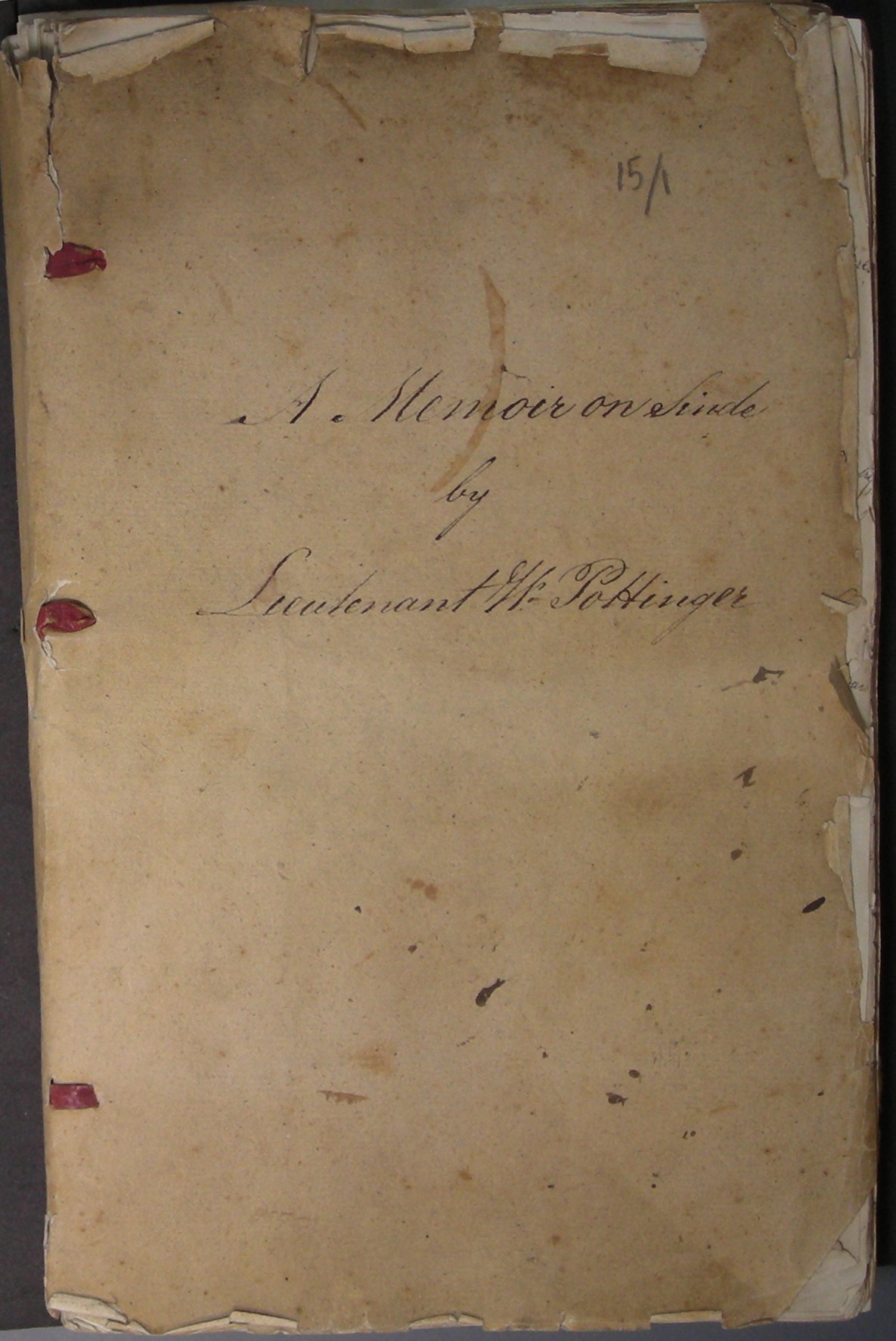
A Memoir on Scinde, H. Pottinger, August 1832. The National Archives, UK.
My research seeks to grasp how culture and knowledge intersect with political economy, state formation, and organizational behavior on a global scale. It has two main threads.
The first thread is an historical analysis of the English East India Company's activities in South Asia from 1757 to 1858. The case of the Company—which began as a predominantly merchant enterprise but became a territorial power after the Seven Years War, and whose administrative apparatus by the early 19th century was more advanced than in Britain itself—provides a crucial historical window into the more general processes by which state administrations modernize, the role of imperial governance in this process, and the different resulting outcomes. Indeed, as Company administrators struggled with one another over how “best” to govern new territory populated by many advanced indigenous societies that they poorly understood, I argue that these administrators unintentionally generated a phenomenon familiar to us today: the sense that administrative action takes place in a world where “state,” “society,” and “economy” seem to be morally discreet bases of action.
My current book project reveals how this key modern notion of morality has its origins in colonial officials' attempts to justify their own controversial behavior. The crucial aspect of this process concerns corruption. In contrast to scholarly approaches today which project modern conceptions of the term backwards into history, I argue that prior to the late Eighteenth Century, “corruption” was primarily understood as the loss of balance among competing passions, and that consequently it was thought to be best regulated by concrete social peers. By contrast, the more familiar modern understanding of corruption depends on the existence of well-defined, purportedly universal moral spaces defining the boundaries of state, society, and economy from one another, and provides a sense of duty (if only nominal) for administrators to emulate—and to rely on during struggles with one another. The key explanation for this shift, I argue, is that the more “modern” understanding of corruption depended on apparently more universal ethical foundations, made struggles among administrators in distant territories more easily intelligible to metropolitan actors, and hence grew in importance as the Company's affairs were increasingly scrutinized in Britain's larger political field. My book manuscript, provisionally entitled Modernity's Corruption, traces out this shift through the Company's internal administrative struggles in the context of Britain's burgeoning empire and the practices moral self-presentation its officials used. Additionally, I have spelled out some of the more general theoretical propositions this argument rests on—particularly when and why accusations of “corruption” tend to take on an abstract, universalistic character—in an article, “A Relational Theory of Corruption.”
In addition to this study of corruption, my earlier research (AJS, 2011) showed that it is not state structures along, but the interaction between conflict and cultural understanding, that best explains the formation of tax systems. Within the Company's tax administration—perhaps the key activity of early modern states (and merchant companies!)—I have asked how intra-administrative conflict within the East India Company led to alternative conceptions of the nature of Indian society, which shaped alternative forms of governance. I published this work in 2011 in the American Journal of Sociology, in “From Reflection to Refraction: State Administration in British India, ca. 1770-1855,” which won awards from the ASA Comparative and Historical Sociology section (Charles Tilly Prize for Best Article) and the ASA Political Sociology Section (Best Graduate Student Paper Prize). It argues that administrators' conceptions of Indian similarity and difference shaped how land revenue administration developed and was distributed throughout India. Thus, instead of classical “reflection” approaches which assume a fit between state organization and social structure, the Company colonial state's view of the Indian societies it sought to govern was uncertain and deeply contested—even within the administration itself. I am continuing this line of thinking in another article, currently in progress, which examines alternative metropolitan framings of the Company's key acquisition of the right to territorial revenues from the Mughal emperor, and how this acquisition touched off a complex framing dispute about the nature of these revenue streams among myriad British and Indian actors.
In this first line of research, I also have three side projects investigating exactly how controversies change our perceptions of right and wrong. The first is a quantitative study of the Company's internal administrative labor market and governance structure in the second half of the Eighteenth Century, which focuses especially on how attention to corruption scandals within the Company eroded the insulation of Company affairs from public scrutiny in the larger British political field. The second analyzes a crucial phase of administrative reform with in the Company in terms of global and transnational fields, arguing that, paradoxically, it was colonial officials' appeals to those outside the administration that generated critical elements of administrators' self-conceptions and the internal logic of the field. Finally, I am developing an overview of contemporary social-scientific approaches to the study of corruption and its role in social change.
If the first thread of my research addresses the role of knowledge, evaluation, and administrative practices in historical change, the second thread moves these questions into a more reflexive and contemporary frame. Here, with several collaborators, I have undertaken an ongoing investigation of the position of historical social science as an interdisciplinary undertaking, probed the methodological underpinnings of the field, and begun investigating a key contemporary theoretical school about colonialism's effects.
In order to clarify the structure of contemporary historical sociology, and to better grasp more generally how social scientists construct their arguments, Damon Mayrl and I have undertaken a project that we call “What Do Historical Sociologists Do All Day? Historical Methods in Theory and Practice.” In a first paper from this project, we survey the sources used in award-winning books and articles in the last two decades. Using a combination of quantitative cluster analysis and intensive qualitative examination of the sources in question, we find that there are at least four systematic patterns of putting primary and secondary works to both theoretical and empirical ends, and we conclude that the field represents a complex landscape which challenges traditional distinctions between theory and evidence. In light of this challenge to contemporary methodological debates in historical social science, which tend to dwell of prescriptive debate rather than acknowledging descriptive differences in practices, we will continue this investigation in a book project and further articles. These further projects will expand our quantitative sample of works for analysis and deepen our engagement with the actual methodological practices of historical social science via systematic interviews with practitioners.
In addition to this project, I am conducting two more collaborative studies on the sociology of knowledge. First, with Jensen Sass (Yale University), I am investigating the intersection of historical sociology with other adjacent fields of inquiry (history and political science). The second project (with Emily Erikson at Yale University), which is in its data collection stage, is a network analysis of the rise and diffusion of the concept of “post-colonial theory”.
[ Home | C.V. | Contact | Papers | Research | Teaching | Personal ]